From the rooftop of Royal London Asset Management’s London offices, the city stretches out below, a fitting backdrop for a conversation about an industry that is changing almost beyond recognition.
 From this picturesque location, The TRADE meets with Kevin Flood, head of trading and execution analytics at Royal London Asset Management (RLAM). It’s a substantial mandate as the role oversees a multi-asset team covering fixed income, equities, FX, ETFs, and OTC derivatives, alongside a dedicated quantitative analytics capability.
RLAM is an unquestionably successful desk, well-regarded across the industry, and assuming responsibility for the multi-asset trading offering is no small feat. Flood took the helm back in 2021 and has since led the desk to new heights. Just last year, the team picked up the Trading Desk of the Year award at The TRADE’s Leaders in Trading Awards 2025, a hotly contested and prestigious accolade, voted on by the entire industry.
Flood describes his tenure at RLAM thus far as “quite the journey,” adding that the award win was “a fantastic recognition of what the team has built over such a short period of time”.
His focus, he shares with The TRADE, has been on transforming the trading function into a strategic partner for the firm’s investment teams.
“On the buy-side, you aren’t just managing to short term limits, budgets or balance sheet constraints; you are a true strategic partner to portfolio managers and your clients, helping to shape trade ideas, constructing workflows, and preserving alpha. The breadth of responsibility – from building integrated multi-asset desks to driving data science and AI applications directly onto the desk – is immense.”
The TRADE sits down with Flood to learn more about his journey to the desk, the main lessons learnt, and what’s next on the agenda.
All roads lead to the buy-side
Flood’s path to becoming a head of trading began on the other side of the desk, in a trade support role at Deutsche Bank – an experience he credits with providing an invaluable foundation for what would follow.
“Not only did it give me an end-to-end view of the trade lifecycle and operational infrastructure, but it also helped to develop the necessary skills to survive a fairly ‘lively’ trading floor!”
Four years later, Flood made the move onto the desk, joining the Loan Exposure Management Group (LEMG) as a credit trader, working across London and New York. At the time, LEMG was pioneering a new approach to loan portfolio management, transforming traditional ‘buy-and-hold’ loan books into actively managed businesses through CDS hedging, transfer pricing, capital optimisation and credit risk transfer techniques.
For Flood, being part of the group at such an early stage of his career provided an important grounding in the mechanics of risk and liquidity management.
“Being on the ground floor of a market-leading team gave me an incredible insight into risk analytics and liquidity management early in my career. As well as the technical skills I was developing, I had a front row seat to a relentless sequence of market crises. Starting with the 2008 Global Financial Crisis, Eurozone Sovereign Debt Crisis, Taper Tantrum, the list goes on.”
Of course, for a credit trader, traversing these episodes and dealing with extreme bouts of volatility was an understandably steep learning curve, however with this experience came invaluable lessons.
“Navigating extreme liquidity distortion, severe dislocations across credit spreads, and massive central bank policy shifts helped build a deep resilience, a healthy respect for liquidity risk, and a level of market judgment that you simply cannot learn from a book,” affirms Flood.
By 2016, Flood was ready to take that experience closer to the end investor. He moved to the buy-side, joining Deutsche Asset Management as a senior fixed income trader, where he helped establish a new trading desk in London.
The venture was ultimately short-lived, with Brexit bringing the project to an abrupt end. But another door soon opened in 2018.
“An amazing opportunity at Royal London Asset Management arose to establish a new, centralised dealing desk for all fixed income trading,” Flood explains. He was subsequently recognised as one of The TRADE’s Rising Stars of Trading and Execution the same year.
The move to RLAM marked a significant chapter in Flood’s career, shifting his focus towards building and developing a centralised trading function and bringing together the experience he had accumulated across both sides of the industry.
Despite having started out on the sell-side, for Flood, the buy-side is home. Reflecting on his journey to his current role, he shares that if he had his time again, his “biggest pivot would be making the transition to the buy-side slightly earlier in his career”.
He adds: “I spent 15 incredible years in an investment bank, through periods of extreme market turbulence and market structure change, providing an extraordinary foundation in risk management and trading through volatile market cycles.
“However, once I moved into asset management, I instantly realised how rewarding it is to be aligned directly with long-term investment outcomes and ‘real money’ end-clients.”
Yet despite this – like many across the industry – he allows that there is very little which compares to having experienced life on the other side of the road before reaching one’s ultimate career destination.
“I certainly wouldn’t trade the hard-earned lessons from my investment bank days, but getting to experience the client-centric, collaborative dynamics of a buy-side desk earlier would have given me an even longer runway to innovate in this space,” Flood enthuses.
 Reflecting on the lessons learnt throughout his tenure, it becomes clear that for this head of trading, the industry remains very much a people-driven business at its heart.
Though we live in an increasingly technological world, for Flood it’s of the utmost importance that traders don’t hesitate to leverage who they know, to ask questions at every opportunity and learn from the people who surround them.
“There is an enormous amount of institutional wisdom sitting across the desk and across the street if you take the initiative to seek it out,” says Flood.
“Never underestimate the power of human connection, picking up the phone, and proactively building your network. In an industry increasingly dominated by screens, algorithms, and chat messages, the ability to pick up the phone or grab a coffee, speaking directly to counterparties, and building real trust is a massive differentiator.”
What it means to be a modern trader
When it comes to his approach to the role of head of trading and execution analytics at RLAM, Flood emphasises that the structure and culture of the wider organisation have a direct bearing on how the trading function operates. As part of Royal London, the UK’s largest customer-owned mutual, the firm takes a long-term approach to investment, with active management and responsible stewardship central to its proposition.
“We aren’t driven by short-term market noise or quarterly shareholder demands. Instead, our proposition is built around active investment management, long-term value creation, responsible stewardship, and acting with conviction and integrity,” he explains.
That philosophy extends into the way the trading and execution analytics team works alongside the wider investment organisation. Rather than treating execution as a function that sits separately from the investment decision, the desk is positioned as a partner to portfolio managers, with its role extending beyond simply implementing trades, explains Flood.
On the desk, traders are embedded within the investment process, while technology and quantitative expertise are brought directly into the trading environment.
“By embedding trader expertise, data science, and custom technology right onto the desk, we align execution strategy directly with investment intent,” affirms Flood.
He further explains how the desk itself is organised – across three specialist trading pods, covering equity trading and rates, FX and derivatives, and credit. While each area retains its own expertise, the structure is designed to allow the wider team to respond flexibly as trading requirements shift across asset classes.
“Cross-pod coverage ensures the desk remains highly adaptable with continuous multi-asset trading capability,” adds Flood.
“We also have a dedicated quant capability embedded on the desk, driving on-desk analytics, custom TCA and workflow automation. This allows development of bespoke pre-trade tools, data infrastructure, and AI applications right next to the traders using them.”
That combination of market expertise, quantitative analysis and technology also feeds into the way Flood approaches building the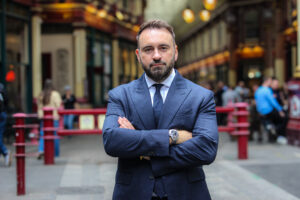 team itself. While the technical requirements of trading have evolved, he says the starting point for any new hire remains a genuine interest in markets.
For Flood, enthusiasm cannot simply be taught, he tells The TRADE. Candidates need to demonstrate a curiosity about what moves markets and an appetite for understanding the forces behind price and liquidity – qualities that provide the foundation on which more technical skills can be built.
“When hiring, I love seeing someone who has a genuine excitement for markets and an authentic interest in trading. You can teach someone the basics, but you can’t fake an innate passion for how news, geopolitical events, and liquidity move markets.
“Today’s ideal candidate combines market intuition with data literacy. They don’t need to be developers, but they must be comfortable interrogating data, using analytical platforms, and applying tech-driven insights to execution strategies.”
Demonstrably, the profile of a successful trader has broadened, and for Flood what is paramount are individuals who can combine traditional market judgement with a willingness to engage with analytical tools and new sources of information.
This of course echoes the broader shift in what it means to be an ideal modern trader: market knowledge remains fundamental, but increasingly sits alongside the ability to interpret data, work with technology and translate new analytical capabilities into better execution decisions.
Looking ahead
Flood has now spent more than two decades in trading, a period that has seen the function transformed by technology, electronic execution and the growing importance of data. The contrast between the desk he joined at the beginning of his career and the one he operates today is stark.
“The evolution over the last two decades has been profound. When I started out, we actually used the phone! Jokes aside, workflows were largely manual, fragmented, and heavily reliant on legacy, and often, antiquated systems. Today, buy-side trading operates in a highly automated, data-rich environment dominated by electronic platforms, algorithmic execution, and straight-through processing.”
He goes on to highlight how that technological shift has also changed the nature of the trader’s role. As more routine execution becomes automated, the value of the human trader increasingly lies in the decisions that technology cannot easily make – particularly when markets become less liquid or more complex.
The fundamental role of the trader has transformed as a result. With the advent of increasing technology, traders are now able to focus on the execution alpha trifecta.
“Rather than acting simply as execution order-takers, modern traders are proactive decision-makers and risk managers. Automation allows efficient handling of standardised flow, freeing up the desk to focus on complex, illiquid transactions where trader insight, market connectivity, and relationship management deliver true execution alpha,” explains Flood.
He adds: “The day-to-day experience of a trader on our desk is significantly more dynamic, analytical, and higher-value than it was in the past […] the trading desk sits in a unique position within the firm. Our traders have a deep understanding of our portfolio managers and their specific investment mandates. Combined with access to a vast suite of pre-trade data, liquidity metrics, real-time axes, venue analytics and counterparty performance – traders now have the cutting-edge tools required to rapidly transform that data into actionable execution opportunities and alpha.”
 If the last 20 years have been defined by automation and electronification, Flood expects the next phase of change to be shaped increasingly by artificial intelligence. The pace of development means some of the tools that currently feel relatively new could become standard parts of the trading workflow within just a few years.
“I’d expect over the next few years, generative AI and low-code tools will be standard across buy-side desks, allowing traders to query complex market datasets and build custom analytics using natural language rather than writing manual code.”
“In five years, I’d like to think – and hope – more manually intensive asset classes like credit and OTC derivatives markets will reach new levels of electronification and transparency, with automated execution handling an even broader percentage of routine flow.”
Further out, Flood envisages a trading desk that looks less like a traditional execution function – with AI taking on an increasing share of the operational workload while human expertise becomes concentrated in the areas where it adds the most value.
“In 10 years, I’d like to see the desk operating as an advisory and quantitative execution hub. AI agents will handle pre-trade routing, compliance checks, and post-trade analytics autonomously, while human traders provide high touch advisory services, navigate complex market dislocations, and manage strategic liquidity relationships,” he says.
For now, however, Flood’s attention remains firmly on what can be built at RLAM. The longer-term vision may involve increasingly autonomous technology, but the immediate priority is continuing to bring together data, AI and trading expertise in a way that delivers tangible benefits for the investment process and, ultimately, clients.
“We’ve laid a solid foundation, but as market structures evolve, there is always room to innovate our operating model, expand our quantitative capabilities, and pioneer new execution technologies,” enthuses Flood.
As the conversation circles back to reflect on a career that has taken him to the helm of a leading trading team, Flood is clear that two decades in the markets have offered plenty of lessons – and that standing still has never been an option.
“The most important lesson I’ve learned is to remain humble, stay intellectually curious and embrace change. Markets, technology, and regulations shift constantly; the moment you assume you have everything figured out is the moment you fall behind.”