With less than 40% of equity volume now trading on primary exchanges, legacy benchmarks increasingly fail to reflect where  liquidity truly resides. As fragmentation deepens across exchanges, MTFs, dark pools and bilateral venues, firms risk misjudging execution quality unless they adopt smarter, independent reference prices shaped by their actual trading footprint. The trading industry’s next edge lies in smarter measurement, not speed, writes Robin Mess, co-founder and chief executive, xyt.
For decades, traders could glance at the primary exchange and know where the market stood. Today, that simplicity has vanished. Regulation, technology, and heightened competition have dispersed liquidity across numerous venues. From dark pools to the rise of bilateral trading, what was once a single, reliable reference price has become an ever-moving target. Yet many financial institutions still treat the primary exchange price as gospel. But given the fact that less than 40% of equities volume now trades on the primary exchange, why should they?
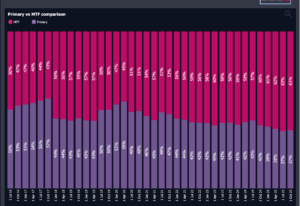
To answer this question, it is first important to realise that in modern-day, computer-driven equity markets, the reference price isn’t just a number on a screen. It’s the yardstick by which firms measure best execution, evaluate strategy performance, and judge how effectively they compete with their peers. But as liquidity continues to fragment across national exchanges, multilateral trading facilities (MTFs), dark pools, and bilateral deals, the old one-size-fits-all benchmark no longer suffices. Financial institutions now need reference prices that reflect the specific liquidity they actually access.
With so many pools of liquidity, a trader may never interact with some of them. This raises another question – should trades in those venues influence the reference price they use? For many traders, including non-accessible trades can be misleading, distorting execution metrics and the evaluation of investment strategies.
Reference prices also need not align with the prevailing mid-price at execution. In many cases, particularly for exchange-traded funds (ETFs), the meaningful price is the one at arrival, when a request for quote (RFQ) is first issued. At that moment, the state of the market, the risk of toxicity, and the potential slippage define the trade far more than the eventual execution price.
Recognising these nuances is the first step towards a smarter, more precise approach to benchmarking. Firms can move beyond generic reference prices to those that genuinely reflect how and where they trade. Independence and objectivity are critical here. Only by analysing their own data impartially can firms build benchmarks that reveal true performance, free from bias or conflicts of interest. This is the only way to truly ensure that benchmarks are free from the influence of counterparties with vested interests.
Regulators are already nudging the market towards greater clarity. The Financial Conduct Authority (FCA), for example, has cleaned up market data by removing non-price-forming trades. Yet it would be complacent for institutions to assume this is enough. They can go further, using continuous, data-driven decisions to design bespoke reference prices tailored not only to their strategies but also to their unique liquidity footprints.
Fragmentation isn’t just a European phenomenon. The rise of bilateral trades and private trading rooms in the United States adds another layer of complexity, reshaping who can access what liquidity and when. In such a market, a single benchmark is becoming increasingly irrelevant.
On the plus side, firms now have access to more granular data than ever. This information can be harmonised, contextualised, and transformed into actionable intelligence. The smartest traders recognise that a reference price is not a market decree but a reflection of their own interaction with liquidity. By defining benchmarks through continuous, independent analytics, financial institutions can ensure their metrics are meaningful, their execution measurable, and their strategies genuinely aligned with the instruments they trade. The industry’s next competitive edge will come not from faster trading, but from smarter measurement. Those who redefine their reference points will ultimately redefine performance itself.