Up against fierce competition, UBS Asset Management’s Stuart Lawrence was voted Industry Person of the Year 2025 by his peers, following a live ballot at The TRADE’s Leaders in Trading Awards in November. He is the first buy-side nominee to ever receive the accolade.
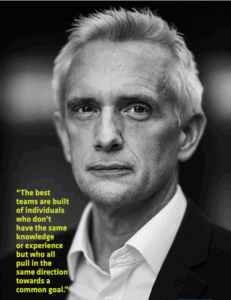 Speaking to The TRADE about the recognition, which distinguishes an individual proactively working to change markets for the better, Lawrence affirms: “We all have a responsibility to make the markets better and that hasn’t really changed in my time in the City. It is easy to think that the evolution will be decided by forces beyond our control but there are mechanisms and institutions that exist to give a voice to both the buy- and sell-side.
“Change can come in the form of regulation or initiatives that have formed to drive improvement. The exchanges, venues and brokers want to hear what matters to the firms that use them – and the dialogue can lead to positive change. That doesn’t mean you have to be involved with every initiative. Just find the one that excites you.”
Despite a mention of ‘imposter syndrome’ during his on-stage acceptance speech, Lawrence has demonstrably more than proven his capabilities, with the success of his desk further corroborated with the team’s ‘Trading Desk of the Year’ award win back in 2022.
His words, imbued with reflections on how far the markets have come and evolved for the better, resonated strongly with an industry looking to embrace the new.
In a time of continued – and accelerating – innovation, Lawrence is continually looking ahead, an approach which has permeated his career thus far and to his current role as head of European equities trading.
When it comes to his successes, Lawrence is quick to heap praise on his teams (both past and present), highlighting how relationships have played a key role in shaping his trajectory thus far.
“I tend to speak a lot about how technology will shape the future, but I don’t want to overlook the fact that this is a relationship business. Speaking to people is as important now as it was when I started. Trust is built on interaction [and] building solid relationships pays long-term dividends.”
Dreaming of ‘Wall Street’
Lawrence began his trading career in capital markets in 2001, having decided early on – at the age of 12 in fact – that the trading life would be a perfect fit.

“I think it’s fair to say that my career has not followed the planned or smooth trajectory I would have imagined when I started, but it’s been an interesting ride. I decided I wanted to join the finance industry after watching the film ‘Wall Street’ when I was 12, despite having no idea what that necessarily entailed, because I thought it looked fun.
“After four great years at university, I joined ABN AMRO’s graduate program and, following the usual rotations (and despite encouragement from numerous people to become an analyst instead), I decided I wanted to be an equity trader.”
Beginning a career in market making is by no means an easy feat, as Lawrence is quick to admit. However, the adage that pressure makes diamonds certainly appears to ring true in this case.
“I was definitely naïve when I started as a market maker – it was a baptism of fire and the learning curve was steep,” asserts Lawrence.
Despite not landing in the illicit fictional world depicted in the 1987 blockbuster, Lawrence did indeed join the industry during a particularly interesting period. A time where commission rates were still high, and the market was dealing with the fallout from the dot-com bubble. In Lawrence’s own words “it felt like change was on the horizon”.
Following four years market-making, he made the move to small West End hedge fund Ennismore, focused on mid- and small-cap companies. Here, Lawrence helped to set-up the trading desk from scratch – his first taste of the buy-side.
 Discussing the journey to his current role at UBS, Lawrence explains that the variety throughout his career continues to stand him in good stead, influencing his approach to leading the EMEA equities desk.
“[At Ennismore] I learned the demands of that side of the business. When the financial crisis hit, I took a year off to travel and to tick-off some of my bucket list and in 2010, I joined Instinet as a sales trader for US clients, with some portfolio trading added to the mix. After that followed a whistlestop couple of years.
“I moved back to buy-side trading with Principal Global Investors, but two years later had to decline a move to Singapore. From there I joined Kepler Cheuvreux briefly to cover US clients but when the UBS Asset Management job came up, I knew it was what I was looking for.”
Lawrence joined UBS AM in June 2019, subsequently becoming head of the London trading desk in December 2021 before taking responsibility for equities trading for the EMEA region three years later.
“Having spent almost the same amount of time on both sides of the industry, I have gained significant insight, both in understanding of the different roles but also in empathy for how my actions affect those I interact with […] Though there were more changes of jobs in a short period than I would have liked, all gave me experience and insight into how different firms do things.”
The cusp of the next trading revolution
Delving deeper into how have things changed during his tenure, both the overall trading sphere and a traders’ respective day-to-day work, Lawrence highlights three key pillars contributing to the evolution – technology, market structure and attitudes.
 “Technology has been the game-changer of the last 20 years and has provided countless benefits for trading desks, and the industry as a whole, dramatically improving efficiency,” he explains.
“[…] Through the improved technology, desks are now able to execute exponentially larger flows than in the past, with fewer resources. This is advantageous but that requires greater diligence and oversight.”
Specifically, he emphasises that the key technological advancements include algo wheels, bilateral liquidity feeds direct into EMS’, and the ability to scale.
“Traders now have much more control, more information. The options of how to trade have grown substantially, with different and new venue types, enhanced risk options and a plethora of different algo suites with nuanced offerings. But all of this comes with more responsibility. A buy-side trader has to understand these tools, utilise them in the best possible way and mine the post-trade performance data.”
He adds: “When I first started, we had to manually work out the VWAP execution strategy for each order on a bit of paper. With the advent of algorithms, traders have stopped needing to execute orders ‘by hand’, allowing them to utilise their time more effectively by focusing on trading strategies and innovate through new and better execution options […] With the advent of AI, I think we are at the cusp of the next trading revolution.”
On the market structure side, the notorious Mifid and Mifid II developments have lived up to expectations, truly shaking up the old industry model with regards to transparency and commissions, says Lawrence.
“There is now a steady, but consistent, evolution within market structure, with exchanges, venues and regulators all working on transformation”.
Simultaneously, alongside the empirical evolution of the industry, there have also been important developments among the people behind these businesses. Lawrence describes this as “a sea of change in attitudes”, a trend which he asserts is equally as important as market developments.
In his acceptance speech at the Leaders in Trading Awards, Lawrence delved further into this, enthusing that “the dramatic evolution has been driven by every one of you [in this room tonight] in some way. We need to help keep the momentum that has been so hard fought and won to continue into the future.”
He added: “Trading has traditionally been where the loudest voice won the argument, and mentoring was an afterthought. Now, we’re at the tail end of 2025 – there’s better inclusivity, greater diversity, deeper respect, and the industry finally acknowledges that mental health is a serious issue that must be addressed.
“I raise this because there’s always more that we can do to help the younger generation succeed in this industry. Tonight, we are gathered here as leaders of trading, and we need to live up to that mantle.”
Fostering talent
When it comes to hiring within the trading sphere, the constantly evolving nature of the game continues to play an increasingly important part in the make-up of firms. For Lawrence, the bringing together of an effective desk is a thoughtful process, with longevity and future growth key considerations.
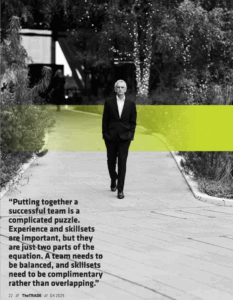 “Putting together a successful team is a complicated puzzle. Experience and skillsets are important, but they are just two parts of the equation. A team needs to be balanced, and skillsets need to be complimentary rather than overlapping.
“The best teams are built of individuals who don’t have the same knowledge or experience but who all pull in the same direction towards a common goal.”
Speaking about his team at UBS AM specifically, Lawrence asserts that his own preference is to work with people who are constantly challenging both him, and the status quo – those who look to help evolve the desk. In the same vein, he explains that the firm itself seeks out individuals who are self-motivated and are clear on their goals and what they want to achieve.
Lawrence adds: “It is clichéd to talk about being a team player but that doesn’t make it any less important. I would not want to hire an individual who prefers to be a lone wolf or someone who would disrupt the balance by being self-focused. Success can be achieved as part of a team.
“Hiring the wrong person could be disastrous for morale so I always look out for these traits.”
Looking back at one’s own career is always full of mixed emotions, with the line between a lesson and a regret often very thin.
As Lawrence himself puts it, “hindsight is a trader’s best friend,” as he explains: “I’d be the first to admit there are numerous moments in my career where I would go back and change things. If I am honest, these are situations I could have resolved at the time but didn’t, whether through a lack of knowledge or lack of motivation. On occasion, I have become too complacent or comfortable in a role, and consequently lost focus and drive.
“[…] In retrospect, I should have made the change but didn’t and that failure sits with me. When you are not learning new things or interested in what you are doing then it is a slippery slope.”
Addressing what he would do differently if given his time again, Lawrence highlights the importance of a mentor and proactively seeking one out, adding that doing so is one way to bolster the confidence to ask questions.
He tells The TRADE that to begin a career in capital markets is no mean feat, with only those truly dedicated set to succeed. Especially given that wins aren’t immediate and require a lot of hard work.
“The industry is not getting any easier, so anyone who wants to join it needs to be truly committed to their ambitions. Firstly, they need to back themselves, be a self-starter and have confidence in their ability. They should ask questions, for understanding to begin with but later to challenge. They should proactively read around various market topics and if things don’t make sense – ask the question.
“Networking is also key (and something I struggled with for many years), get to know people – both your internal peers and people outside your firm. Ask to attend events and talks. Conversation is a key to learning. Try and find a good mentor; someone you trust who is prepared to give you their valuable time in helping you. Finally, don’t take your position for granted, things can change quickly.”
On the horizon
Asking a trader to look towards the year ahead and predict what’s to come is never an easy question – things move at a rapid pace across financial markets at the best of time, but 2025 has certainly been a particularly lively year.
For Lawrence, the main focus of his attention over the last 12 months, has been the merging and integration of the Credit Suisse Asset Management trading desk business and the centralisation of all European trading within London.
 For 2026, the priority will now be looking to streamline and enhance the London equities desk, whilst keeping a close eye on the markets’ irrevocable advancement in order to ensure that the team is primed to adapt quickly amid an increasingly unpredictable industry.
“The next major evolution will be the full integration of AI into a desk’s processes.
“At UBS Asset Management we are already embracing this technology, but we are only at the dawn of its use. The speed at which we can fuse the workflows for traders and AI will depend on breakthroughs and innovation, and while I do not yet know what our future solutions will look like, I believe the result can only be enhancing.
“I have heard concerns around the adoption of AI and what it means to human traders but I think a trading desk should welcome, not fear, its arrival. I will encourage my team to embrace it and be the architects in driving how we employ it to our advantage.”
Lawrence demonstrably remains a proponent of proactively future-proofing the industry he has been part of for 25 years, and endorses a practical approach in sowing the right seeds for the next 25 years to come.
“My goal for the team is to ensure we are at the forefront of industry change and early adopters of the latest technologies […] We already have a long list of improvements we want to make and I can see that list growing as we delve deeper into the various subjects.”
Lawrence has ambitious plans for his team going forward and with his focus firmly on the future, he is no doubt set to continue his impressive run amid an ever-shifting landscape.
Success, Lawrence explains, hinges on the ability to remain at the fore of change.
“To be on the front-foot at all times; to remain curious, to ask questions and to challenge the status quo.”
Access the full e-version of the Q4 2025 magazine edition here.